
The Changing Face of US AI Regulation: How Federal Rollbacks Are Driving State Laws and Legal Standards
The US AI regulatory landscape has transformed dramatically in early 2025. This change centers on three major shifts: the Trump administration's reversal of previous federal AI regulations, new state-level AI laws taking effect, and emerging workplace AI litigation. For businesses using or planning to use AI, understanding these regulatory changes is crucial for compliance and risk management.
The Changing Face of US AI Regulation: How Federal Rollbacks Are Driving State Laws and Legal Standards
-
In early 2025, the U.S. AI regulatory landscape shifted significantly with the Trump administration's rollback of federal oversight.
-
This federal deregulation has been followed by a rise in new state-level AI laws and increased workplace litigation related to AI use.
-
While federal compliance requirements have decreased, businesses now face a more fragmented and complex regulatory environment.
-
Companies developing or deploying AI must adopt proactive compliance strategies to manage evolving legal risks and state-level obligations.
Breakdown of Key Regulatory Developments
Major Federal AI Regulatory Changes (2025)
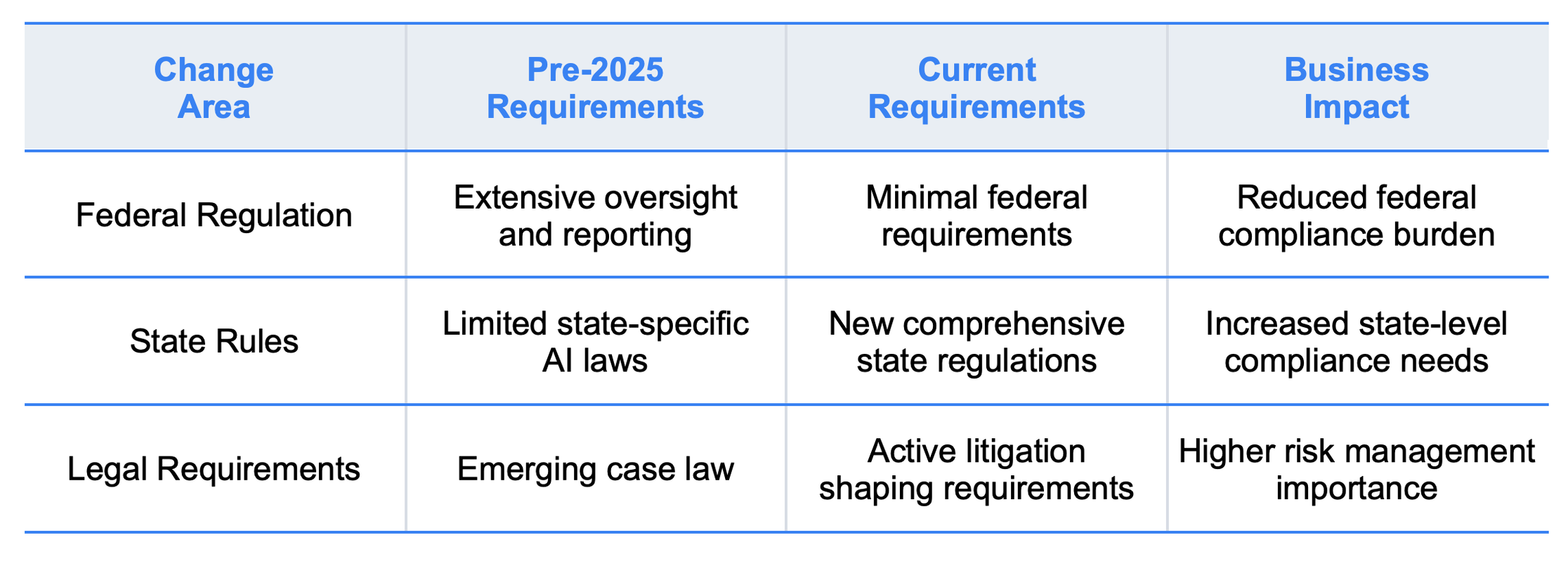
Recent federal changes have reshaped AI oversight. The Trump administration reversed Biden's 2023 AI Executive Order, effectively removing federal oversight requirements. In its place, the January 2025 executive order introduces a new direction that emphasizes U.S. leadership in AI and reduces regulatory barriers. As a result, companies now face fewer federal restrictions, but bear greater responsibility for self-regulation.
The practical effects of these changes are already being felt. Federal AI safety assessments, which were previously mandatory, are no longer required. Additionally, reporting requirements for AI systems have been significantly reduced. Despite this decrease in oversight, businesses are still expected to maintain robust internal controls to ensure responsible AI use.
New State AI Regulations (2024-2025)
The regulatory gap left by federal changes has prompted new state laws:
Recent State Laws
-
Colorado (Late 2024): New mandatory risk assessments for high-risk AI systems
-
Texas (Early 2025): Pending TRAIGA legislation requiring transparency in AI decisions
-
California (2025):Proposed strict requirements for automated decision systems
Navigating New Requirements
Most new state-level AI regulations are scheduled to take effect throughout 2025, creating a staggered compliance timeline for businesses. These laws introduce new documentation requirements, compelling companies to generate formal records of their AI systems and how they function. Additionally, businesses must keep track of varying implementation deadlines across states to ensure timely and complete compliance.

Latest AI Workplace Litigation Trends
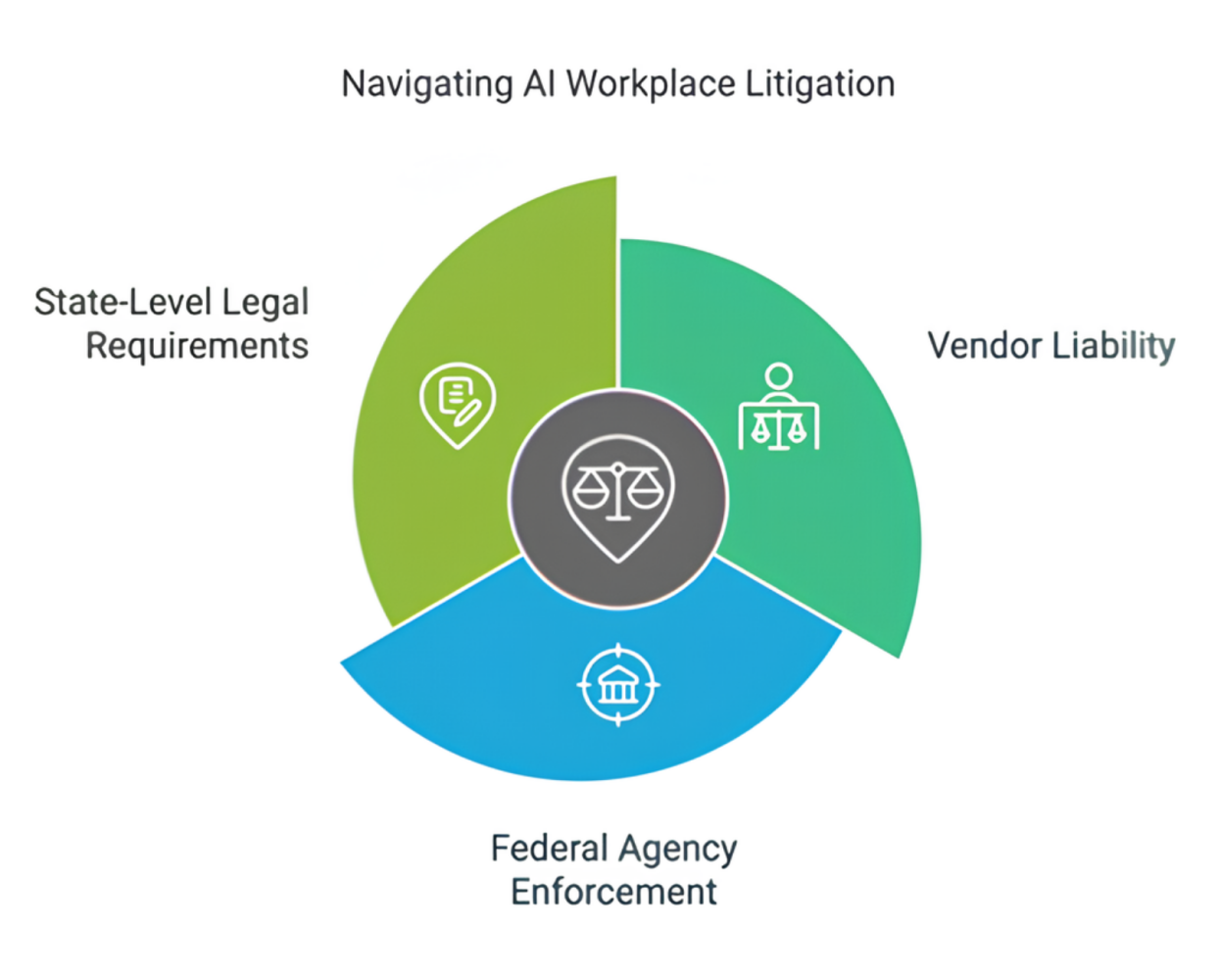
The landscape of AI workplace litigation has evolved significantly, with three major developments shaping how companies must approach AI in employment:
Landmark Cases Establishing Vendor Liability
The Mobley v. Workday, Inc. case has fundamentally changed the liability landscape for AI in the workplace:
-
Courts now recognize that AI vendors can be held liable as "agents" of employers
-
Both employers and AI providers face potential liability for discriminatory outcomes
-
Claims of systemic discrimination through AI tools are being allowed to proceed in court
-
The case sets precedent for challenging AI systems that show bias in race, age, and disability screening
Increased Federal Agency Enforcement
Federal regulators are taking an aggressive stance on AI discrimination:
-
EEOC secured its first AI discrimination settlement involving age bias in hiring
-
FTC has launched investigations into major AI hiring tools, including AON's personality assessments
-
Regulatory focus has expanded beyond traditional discrimination to include:
- Algorithmic fairness requirements
- Transparency in AI decision-making
- Protection of disabled applicants in automated screening
State-Level Legal Requirements
States are establishing strict new standards for workplace AI:
-
Illinois: Mandatory impact assessments and applicant notifications
-
Maryland: Required consent for facial recognition technology
-
Colorado: Comprehensive anti-discrimination measures for high-risk AI systems
These developments create significant new obligations for businesses:
-
Companies must thoroughly vet AI vendors and secure contractual protections
-
Documentation of AI decision processes is becoming legally mandatory
-
Regular bias testing and impact assessments are increasingly required
-
Clear disclosure to applicants about AI use in hiring is now essential
Regulatory Change Impact Summary
Our Insight
The US AI regulatory landscape has shifted dramatically in early 2025. While federal oversight has decreased, new state regulations and workplace litigation are creating a complex compliance environment. Businesses must adapt to these changes while maintaining effective risk management practices.
Companies need to stay particularly alert to new state requirements emerging throughout 2025, as these may fill the gap left by reduced federal oversight. Success requires understanding these regulatory changes and implementing appropriate compliance measures.
Key Takeaways
-
Dramatic Shift in Federal Oversight: The Trump administration's January 2025 executive order marks a fundamental change in US AI regulation, replacing Biden's comprehensive federal framework with a deregulatory approach that emphasizes innovation and market leadership over mandated safeguards. This shift has significantly reduced federal compliance requirements but places greater responsibility on businesses for self-regulation.
-
Rise of State-Level Regulation: As federal oversight decreases, states are rapidly filling the regulatory void with new, comprehensive AI laws. Colorado's 2024 mandatory risk assessment requirements for high-risk AI systems, Texas's pending TRAIGA legislation, and California's proposed automated decision system regulations represent a new era of state-led AI governance. This creates a complex patchwork of requirements that companies must navigate.
-
Emerging Legal Framework Through Litigation: The intersection of reduced federal oversight and increased state regulation has made courts and regulatory agencies key players in shaping AI governance. Recent workplace discrimination lawsuits and EEOC enforcement actions are establishing new precedents for AI use in hiring and employment decisions, while holding companies accountable for algorithmic bias despite reduced federal regulations.
-
Complex New Reality for Businesses: The current regulatory environment presents a challenging balance: while federal deregulation offers opportunities for faster innovation and reduced compliance costs, the combination of new state requirements and active litigation creates significant risks. Companies must now maintain robust internal controls and documentation while navigating varying requirements across different states.
Note: This document reflects regulatory changes as of January 2025. Consult legal counsel for current requirements.
References
-
Adam Aft, Caroline Burnett, Cynthia Cole, Brian Hengesbaugh, Keo McKenzie, Justine Phillips, Elizabeth Roper, Avi Toltzis. (2025). AI Tug-of-War: Trump Pulls Back Biden's AI Plans. https://www.theemployerreport.com/2025/01/ai-tug-of-war-trump-pulls-back-bidens-ai-plans/
-
The White House. (2025). Fact Sheet: President Donald J. Trump Takes Action to Enhance America's AI Leadership. https://www.whitehouse.gov/fact-sheets/2025/01/fact-sheet-president-donald-j-trump-takes-action-to-enhance-americas-ai-leadership/
-
Robert Huffman, Nooree Lee, Ryan Burnette, Matthew Shapanka, August Gweon. (2025). January 2025 AI Developments – Transitioning to the Trump Administration. https://www.insidegovernmentcontracts.com/2025/02/january-2025-ai-developments-transitioning-to-the-trump-administration/
-
The Colorado AI Act Shuffle: One Step Forward, Two Steps Back. (2025). https://www.bakerdonelson.com/the-colorado-ai-act-shuffle-one-step-forward-two-steps-back