
LLAMA Community Licenses: Understanding the Terms of Use Across Versions 3.1, 3.2, and 3.3
In recent years, Meta’s Llama family of large language models (LLMs) has gained significant traction among developers, researchers, and enterprises. Alongside rapid improvements in model performance,the Llama 3.x releases (3.1, 3.2, and 3.3) introduced Community License Agreements that shape how these models and their derivatives can be used, reproduced, and distributed. These agreements reflect Meta’s attempt to balance openness with certain constraints—ranging from attribution requirements to commercial usage thresholds.Understanding the distinctions among Llama 3.1, 3.2, and 3.3 licenses is key for users who integrate Llama-based models into software products or AI services. This article summarizes the common provisions, highlights notable clauses, and clarifies the business impact of adopting Llama 3.x models in various enterprise settings.

LLAMA Community Licenses: Understanding the Terms of Use Across Versions 3.1, 3.2, and 3.3
-
Meta’s Llama family of large language models (LLMs) has seen widespread adoption across the developer, research, and enterprise communities.
-
The Llama 3.x versions (3.1, 3.2, and 3.3) introduced Community License Agreements that govern usage, reproduction, and distribution of the models.
-
These licenses aim to strike a balance between open access and responsible use, including requirements like attribution and commercial usage thresholds.
-
Understanding the differences across Llama 3.x licenses is crucial for organizations integrating Llama into products or services, especially in terms of legal, branding, and operational impact.
The Innovation Breakthrough: Licenses That Aim for Openness with Accountability
Although licensing terms are not often labeled as “breakthroughs,” Meta’s approach to Llama 3.x is innovative in how it seeks a middle ground between free usage and brand consistency. Across versions 3.1, 3.2, and 3.3, the licenses share the following key attributes:
Grant of Rights
Each version grants a non-exclusive, worldwide, royalty-free license to use, reproduce, distribute, copy, and modify the Llama Materials. This broad permission facilitates experimentation, the creation of derivative works, and integration into AI products.
Attribution and Branding
The licenses require you to include the phrase “Built with Llama” on websites, documentation, or other end-user interfaces if you distribute or offer a product that includes Llama. Additionally, if you create a new AI model derived from Llama, you must prepend “Llama” to the model’s name (for example, “Llama-SpeechGen”).
Acceptable Use Policies
All Llama versions incorporate references to an Acceptable Use Policy, ensuring that any usage complies with local laws and trade regulations.
Commercial Threshold
A pivotal and somewhat unusual clause requires high-traffic services (with over 700 million monthly active users) to seek a separate commercial license from Meta. This helps Meta oversee large-scale commercial deployments while still permitting smaller entities to integrate Llama freely.
Derivative Works Ownership
Users own the derivative works they create from Llama, subject to Meta’s underlying ownership of the original Llama Materials.
By structuring each license around these core points, Meta maintains a measure of brand coherence while still fostering open research and community-driven innovation.
Business Impact
License Threshold and Commercial Scale
Each Llama 3.x license includes a clause stating that if a company’s products or services exceed 700 million Monthly Active Users (MAU), the company must obtain a separate commercial license directly from Meta. In practical terms, this means that most small to medium-sized enterprises can use Llama 3.x freely under the community license, reducing both time-to-market and licensing costs. However, larger technology companies or platforms with massive user bases—such as social media giants or major streaming services—would need to negotiate directly with Meta, introducing added complexity and potential licensing fees.
Branding and Attribution Requirements
The license requires that any product incorporating Llama or its outputs must display the phrase “Built with Llama” on relevant user interfaces, websites, or documentation. From a business perspective, this functions as a form of co-branding with Meta. Startups may view this as a credibility boost, showcasing their use of trusted technology, while larger companies might see it as a branding constraint or minor inconvenience. Product teams should plan for this requirement in their UI design or marketing materials.
Additionally, any new AI model derived from Llama must include “Llama” at the beginning of its name, such as “Llama-CodeGenPlus.” This naming convention can benefit smaller developers by signaling the model’s lineage and quality. However, enterprises that prioritize brand independence may need to carefully consider how this requirement aligns with their overall branding strategy.
Risk Management and Legal Compliance
Users must comply with Meta’s Acceptable Use Policy—violations like unlawful or harmful use can result in license termination. Organizations should involve legal or compliance teams to ensure applications meet policy standards, adding minimal but necessary oversight.
Breaching license terms, such as failing to attribute or exceeding the 700 million MAU limit without approval, may lead to termination and legal consequences. To manage this risk, businesses should document usage and monitor user growth, initiating contact with Meta if nearing the threshold.
Ownership of Derivative Works
The license clarifies that while Meta retains ownership of the original Llama Materials, developers maintain ownership of any derivative models or modifications they create. From a business perspective, this encourages innovation by allowing companies to build specialized AI solutions—such as those for healthcare or finance—without sacrificing ownership. It also enables organizations to protect their unique model improvements as intellectual property, while still adhering to the requirement to acknowledge Llama’s origins.
Cost and Operational Efficiency
As long as an organization remains below the 700 million MAU threshold, it can use Llama without paying royalties or license fees. This significantly reduces AI development costs, making it especially beneficial for startups and mid-sized tech companies. From a business perspective, it opens access to advanced language models without the burden of high overhead, helping to democratize AI innovation and lower the barriers to entry.
Additionally, because the license terms are consistent across versions 3.1, 3.2, and 3.3, organizations that have already integrated an earlier version of Llama can more easily transition to a newer one. For R&D and engineering teams, this consistency minimizes friction during upgrades. However, each new version should still be reviewed to ensure that any updates to the license do not affect existing commercial or distribution strategies.
Strategic Alignment and Branding Synergy
Having a recognizable brand like “Llama by Meta” can serve as a valuable asset in marketing materials, signaling advanced and trustworthy technology. From a business standpoint, smaller vendors can benefit by associating their products with Meta’s reputation, potentially gaining customer trust more easily. On the other hand, larger vendors may prefer to maintain a distinct brand identity and carefully consider whether co-branding aligns with their strategic goals.
The licenses also promote the sharing of derivative works, as long as proper attribution is provided. This approach helps foster a growing ecosystem of Llama-based solutions. For businesses, this creates opportunities to participate in vibrant developer communities, contribute to plugin ecosystems, and build on specialized use cases such as domain-specific chatbots, NLP tools, or code-generation systems. The result is accelerated development and greater collaboration across the AI landscape.
Expansion and Growth Outlook
For businesses anticipating rapid user growth, it is essential to consider the licensing threshold built into the Llama Community License. Exceeding the 700 million MAU limit triggers the need for a separate commercial agreement with Meta, which may involve fees, usage-based royalties, or additional compliance measures.
From a business perspective, companies with growth-oriented models must factor these potential licensing costs into their budgeting and long-term strategic planning to avoid unexpected delays or financial hurdles.
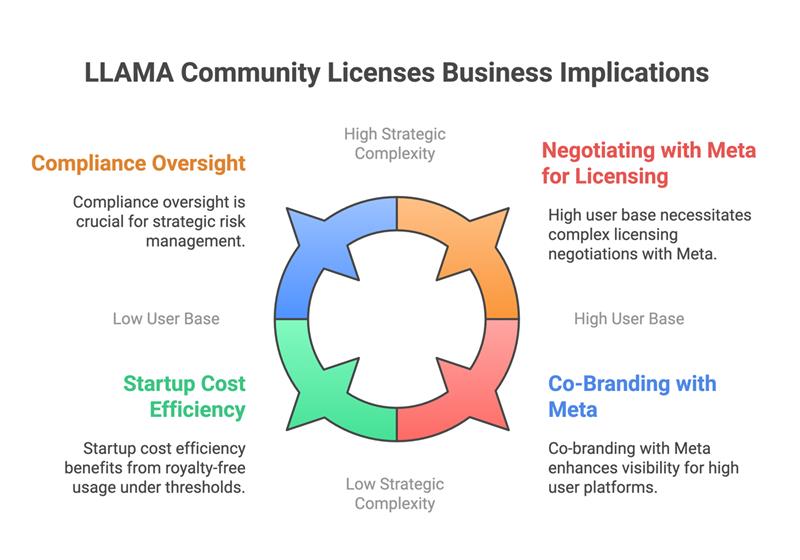
Overall, Llama’s Community Licenses present a pragmatic option for organizations seeking advanced language model capabilities with fewer restrictions than fully closed-source solutions. Companies can achieve reduced overhead costs, faster product development, and co-branding benefits while retaining ownership over innovations. However, they must handle attribution, branding requirements, and the 700 million MAU clause meticulously to avoid legal risks and ensure long-term viability.
Technical Implementation
License File Integration
Distributors of Llama 3.x or any derivative must embed a copy of the relevant Community License Agreement (3.1, 3.2, or 3.3) inside the project. Typically, this is done via a “NOTICE” file.
Model Name Conventions
According to the licenses, if you train or fine-tune new AI systems based on Llama (for example, “Llama-CustomerSupportX”), you are required to adopt the naming convention “Llama” followed by a custom suffix. Additionally, any public release of the model must include the phrase “Built with Llama” in the product documentation or user interfaces.
Acceptable Use Integration
Aligning your user interface and backend workflows with the Acceptable Use Policy is crucial. This might involve blocking certain end-user inputs or ensuring region-specific compliance for data and usage constraints.
Managing Commercial Threshold
For companies approaching or surpassing 700 million monthly active users, a direct conversation with Meta is necessary. In practical terms, a separate license (and possibly fee structure) is triggered, which can delay product launches if not planned in advance.

Our Mind
As Meta continues iterating on its Llama series, licensing terms may evolve in tandem with the community’s feedback and shifting market dynamics. Potential enhancements or clarifications could include more nuanced commercial tiers beyond the current 700-million-user threshold, updated co-branding guidelines for products that incorporate multiple AI backends (such as Llama alongside other open-source models), and extended compliance templates or recommended best practices for developers and integrators.
Regardless of future modifications, Llama’s licenses represent a thoughtful effort to balance open-source innovation with brand protection and responsible usage. For businesses and researchers, the current terms offer a relatively clear and accessible framework for building novel AI applications on top of a powerful large language model—provided that attribution and usage rules are followed carefully.
Key Takeaways
-
Llama 3.x licenses offer flexibility for developers and businesses by allowing royalty-free use, modification, and distribution—provided usage stays below the 700 million MAU threshold.
-
Attribution and branding are mandatory, including the “Built with Llama” label and naming derived models with a “Llama” prefix, which may be seen as beneficial co-branding or a constraint depending on the business size.
-
Derivative works are owned by the developer, encouraging innovation while maintaining Meta’s ownership of the base model. This enables companies to build and protect proprietary solutions.
-
The 700M MAU clause is critical for scalability—exceeding it requires a separate commercial license, making growth planning and usage monitoring essential.
-
Legal and compliance oversight is necessary to ensure alignment with Meta’s Acceptable Use Policy and to avoid termination risks tied to policy violations or improper attribution.
-
Version consistency across 3.1, 3.2, and 3.3 eases integration, reducing friction for teams upgrading models while still requiring legal review of new clauses.
-
Strategic benefits include co-marketing potential and ecosystem participation, making Llama attractive for startups and innovators who value community-driven development and visibility.
References
-
Llama 3.1 Community License Agreement, July 23, 2024. Meta Platforms.
-
Llama 3.2 Community License Agreement, September 25, 2024. Meta Platforms.
-
Llama 3.3 Community License Agreement, December 6, 2024. Meta Platforms.